Tuesday, 31 January 2012

DW: Questions on lighting.

1. Auto exposure - When the camcorder takes care of fluctuating light levels by automatically adjusting the lens aperture in order to keep the same light level.


2. Backlight - A control on the camera that opens the iris in order to expose and bring light to dark or shadowed areas, it may overexpose the lightest areas of the scene, but at lest the subject if properly exposed.
3. Ways that you can control exposure manually:
  •  Reducing or increasing the aperture of your camera will enable you to experiment with the tonal levels and free you from using additional light sources if you are shooting in poor light.
  • Depth of field can also impact the light exposure in your scene, large aperture will create a shallow depth of field i.e. subject in focus quite close to the camera, whereas a small aperture will create a deep depth of field and the subject in the shot will be in focus at a longer distance.
4.The basic shooting modes:
  • Colour slow shutter. Keeps the shutter open for longer to let in more light, but blurs movement and produces a "trailing" effect.
  • Night mode. Also gives you a brighter picture if you're shooting in low light, although it can result in jerky movements as the shutter remains open for longer.
  • Infrared night mode. This mode will shoot in total darkness, giving a green tinge to footage and a "negative effect".
5.You  may need to adjust the white balance if you are quickly filming from indoors to outdoors, in which case there might be a delayed colour shift on the camera, which can look poor. By changing the white balance you are essentially telling the camera what the colour should look like.

MG: Conventions of Thriller openings

Panic Room (Fincher, 2002)
No link found, watched DVD


  • Rhythmic music, ticking over strings, gives sense of suspense
  • Industrial urban location, a conventional horror/thriller setting because of the threat it can provide
  • Blacks, whites and browns used, presenting a bleak but threatening place
  • Slow cutting rate add enigma and increase the threat of the location
  • A mixture of pans and static shots used are very enigmatic because they go against the convention of just using one of them and suggest a sense of uneasiness 
  • Big, bold, strong font for the title and credits overlay the setting of the film and follow the industrial theme of the location, increasing the suspense, it is presented in different angles and is shown as if it were printed on the buildings 

MG: 'Making Video' - Questions on Sound

1. What type of microphone do camcorders have and what issues does it throw up?
  •  it will have an inbuilt omnidirectional microphone that captures sound from all directions
  •  however, it will pick up and amplify all background noise as well
2. When filming, what sounds do you need to take care with?
  • silence as you're mouth is only a few inches from the inbuilt mic on the camcorder
  • finger noise from trying to press buttons near the mic
  • breathing as it will cause camera shake and will be picked up on the mic
  • flapping lens cap
  • the wind, you can put your camcorder on 'wind reducer mode' which will guard against a windy soundtrack
  • hums and buzzes from other electrical equipment nearby, double check that they're switched off to prevent this

Monday, 30 January 2012

Group: Evaluation of Preminilary Task

We managed to shot all of our shots in the space of an hour and ten minutes.
The difficulties we encountered were:
  • Having the shots to create continuity editing.
  • Being able to act in order to make it not look too amateur.
  • When performing a pan shot keeping the characters in centre focus.
  • Creating and putting our own technique/style upon the task.
  • Thinking of how we could best convey our idea to the audience.
  • To achieve a fast cutting rate, build pace and tension of clip.
  • Use a variety of shots in a small period of time, without confusing the viewers.
  • Trying to keep the lighting consistent.
  • Including dialogue that fits in with the situation.
  • Creating a smooth and steady shot, when necessary.
I believe our best shots were during the chase through the corridor, we use quite a few shots in a short space of time. We have all improved in our understanding of how to create a short film and the editing skills which are required.

Sunday, 29 January 2012

AH: Coventions of a thriller opening

Inception (Nolan, 2010)
http://www.youtube.com/watch?v=-VXkUzf1et4
  • The clip begins with a slow motion pan of the sea, emphasising the force and strength of the ocean.
  • We are then introduced to the protagonist, having been swept up on a beach. Straight away there is enigma as we wonder how and why he's there. There is further employment of enigma as he lifts his head to see a little boy and a girl playing with a sand castle (on a desolate beach), you don't see their faces and wonder why their there. 
  • The music which anchors the cuts is a dark rumble to create a sense of danger and/or uneasiness. This supports and builds tension within the opening.
  • Dialogue builds the character exposition of the protagonist and introduces a second character (very old man). They have a connection through an object which was in the possession of the protagonist (a small spinner), it is as if the object has a significance much greater than first thought (enigma).
  • There is then a sudden and unexpected cut, a jump back in time but the exact same location. At this point audiences have no temporal cohesion and requires complete attentiveness to stay with the story (there has been no establishment of what the film will or is about).
  • The old man is now a lot younger, as we see by the use of close-ups. No Long shots are really used in the conversations between the characters, just close-ups to help audiences recognise the relationships that exist between them.

The Dark Knight (Nolan, 2008)
http://www.youtube.com/watch?v=S0KU16cpf8A

  • The opening begins by the introduction of what appears to be robbers, they are wearing masks to conceal or mistake their identity, typical of action thrillers.
  • The window smashing adds to the sense of urgency/chaos and the gunshots are hugely emphasised so there is no way you could miss it. This sense of chaos is further reinforced by the hostages screams.
  • The clip begins with a ticking sound and then the music begins,this is also a common convention in action thrillers to build the pace of the opening.
  • The first shot is an establishing shot of the city which then zooms in to the building in which the robbers appear through the smashed window.
  • There is a low-angle shot of a clown/robber holding a bag, he looks around (as if he is assessing the area). The low-angle shot and prevalence gives an impression of his superiority.
  • All the robbers are wearing clown masks, by command of the joker. They all end up shooting one another also by command of the joker. They all bare guns and this portrays them as dangerous, challenging the common view upon clowns.
  • All through the clip the clowns talk of the joker as having war scars and makes him out to be mysterious (dialogue), this builds enigma to his entrance to the film.

Wednesday, 25 January 2012

MG: How does this opening use the conventions of teen noir?

Brick (Johnson, 2006)
Film Noir period was throughout the 1940's and 50's and had some very individual techniques which are very distinctive:
  • It is particularly recognised for the use of lighting and shadows - it is usually very dark and faces are often obscured by shadows. Venetian blinds are very iconic in Film Noir to create a dramatic shadow effect. 
  • The weather shown in Film Noir is normally very dreary and depressing adding to the pessimism of the content.
  • An iconic prop in Film Noir is a cigarette, often in a cigarette holder, with wispy smoke coming from it, this is usually a prop usually associated with the femme fatale in a sexual manner.
  • The femme fatale is a very conventional character of Film Noir and was seen as particularly shocking in the Film Noir period as she is usually very provacative and seductive.
  • Flashbacks are also very conventional of Film Noir.
Brick and the conventions of 'Teen Noir':
  • The way the character's facial expressions are obscured by the camera angles or by his hands suggest conventions of Teen Noir as faces in Film Noir were also often covered by the lighting, allowing the audience to make their own judgement of the characters' emotions but also to build enigma.
  • A flashback is used, like it often is in Film Noir
  • The girl character is seen as quite provacative and controlling by leaving him a note to make him go to the phone box to talk to her, this could be an interpretation of a femme fatale.
  • The way they talk is very confusing and not very articulate, just like in Film Noir where they talk in sayings and almost metaphors.
  • The fact that a cigarette is thrown out of the car that drives past, shows conventions of Teen Noir as it highlights the iconic prop of Film Noir.

Tuesday, 24 January 2012

DW: conventions of a thriller opening

The usual suspects (Springer 1995)
    http://www.youtube.com/watch?v=t6msq8mgdnE

  • From the very beginning of the film enigma is created via the use of set and character exposition. We see fire in the back ground (established by a medium shot) dead people and leaking gasoline. These things make the audience question what has happened in the scene and therefore keep watching the film to find out.
  • Dim lighting and a sense of film noir helps shroud the man in black, lots of shadows and darkness are conveyed via the use of a long shot with slow panning. The man's face is hidden at all times to perhaps give the audience the feel that this character is the antagonist.

  • This concept is reinforced for example when the blacked out character urinates on the flames which the protagonist deliberately ignited, leading to blow up the whole ship and destroy himself and everything else. This is done casually and ironically by the antagonist and the audience are positioned to sympathise with the man sitting down as his intentions have been prevented.
  • Further enigma is created from the use of dialogue, it makes us ask what has happened in order for things to end up the way they have and also makes us ask who are the characters? "what time is it?" asks the audience - is that important? What relevance to the story is that, therefore encouraging them to watch on and find out.
  • Further noir created by whispy cigarette smoke and the capture of shady boats and docks from medium and longshots.
  • The music is very imortant as it creates tension and a sense of mystery about the scene, it is quite sharp and high pitched but also ranges from quick to slow pace; picking up when something tense or shocking happens i.e. lighting of fuel.
  • Lastly and perhaps most importantly the opening scene leaves questions unanswered; the antagonist is hidden and kept secret, you don't actually see the protagonist shot, why does the camera keep zooming towards a pile of rope? Is there something significant about it? Who are these people and why has this happened? These questions are essential to encourage the viewer to keep watching the film and find out and also to show that the film is likely to conform to the generic expectations of a thriller.


Pulp fiction (Tarantino 1994)


http://www.youtube.com/watch?v=lwusCDRiDwE
  • This film is a thriller, and has been rated the best thriller ever made (by IMDB.com)
  • The audience assumes that there is a background story from the beginning of the film, this is due to dialogue I.e. what the characters talk about. It fulfils the generic expectations of a thriller in that the people are criminals and thrillers very often contain criminal characters.
  • The scene (watched up to 3 minutes) is unusual for the genre in that it has been shot more or less in one take; in a 2 shot, with the addition of a few over the shoulder shots. Thrillers are usually more action filled and tend to use a faster cutting rate perhaps.
  • The dialogue within the text also displays that the criminals actually have intelligence, this is common with some thrillers for example The Dark Knight (Nolan 2008) however in others the criminals come across as less intelligent, thus this film coould be somewhat challenging the generic conventions.
  • Narrative/explanation of the scenario is explained by the two characters on screen - it explains their activities and their intentions via the use of dialogue.
  • The audience is positioned to listen carefully to what the pair are saying, perhaps to observe their intelligence and also future intentions which may/are likely to be relevant to the rest of the film.
  • Via the use of dialogue we identify the characters as criminals, and in particular robbers, the pair seem aggressive and untidy. Although there is diagetic sound such as plates clinking etc. to create verisimilitude the dialogue overpowers this and gives a sense of alienation of the two characters, so that the audience can fully interpret and understand them.
  • The major theme(s) of the scene seem to be that the couple will be robbing the restaurant in the near future (as well can tell by their dialogue).
  • The only tension perhaps in the scene is the possibility that these two people will hold up the restaurant and rob it, their dialogue builds up to this and therefore perhaps create tension. If you watch the scene past 3 minutes they do actually begin the robbery by the end of the scene.

Group: Ideas for Preliminary Task

  • Our idea is to have a scene where Alex is chasing Dan. We will be using a variety of camera shots. 
  • One shot will be a point of view/handicam shot from Alex's view. And then, a couple of shots later maybe Dan's view (being chased).
  • We might include a worms-eye shot of Dan running towards the camera and passing it whilst being chased.
  • We won't include a ELS pan as in the chase scene in tends to slow the pace down and relieve tension upon audiences.
  • Dan runs out of breath and Alex catches him, at this point there will be dialogue. It will be Dan groveling to Alex, pleading for his life. The best shot to use for this would probably be either an over-the-shoulder shot or a high angle shot.
  • Alex doesn't accept and tells him "you should have thought about that before you laid hands on my fiancee!".
  • That is then the end of the scene and the 'starring' titles come up, over-laid upon shots of Alex and Dan.

Monday, 23 January 2012

MG: Conventions of Horror Openings

Orphan (Collet-Serra, 2009)
No link found, watched DVD
  • Title: simple, white capital seriffed letters in the centre, which then flicker with a UV light, turning the font into a child's scrawly handwriting with smudges and fingerprints around it, giving the impression that there is a dark side to children, in this circumstance, an orphan
  • The title then fades into white and then to an out of focus two shot in a hospital alongside eerie music, giving a ghostly sense which is almost like a dream or a flashback, this is also reinforced by the bright white lighting used and also by the echoing of the characters voices
  • The slow pace of editing also emphasises the dreamy effect
  • All shots in the opening are almost blurry by the background being out of focus the whole time, for example, when the pregnant protagonist is being wheeled to reception in a wheel chair, a close up is used where her face is in focus but the windows on the wall in the background are blurry
  • The location and all the props are all white and the protagonists face is very pale, adding to the ghostly sense, however as the opening progresses, the protagonist starts bleeding as she's being wheeled down the corridor, the red of the blood contrasting with the whiteness of everything
  • birds eye view is used directly above her being wheeled down the corridor to reveal the trail of blood behind her 

The Fourth Kind (Osunsanmi, 2010)
No link found, watched DVD

  • Blurry and out of focus, a figure walks towards the camera, building up tension as the music starts.
  • Comes into focus, in a woods, actress starts speaking, breaking the fourth wall, telling the audience that it is a true story and that actual footage is included.
  • Quick cuts between close ups and mid shots are used after each sentence she says to portray a sense of urgency and uneasiness.
  • The music is ghostly and almost churchy, this is very enigmatic as it could suggest death or possibly even murder.
  • The background of the woods starts spinning creating a sense of chaos and reinforcing the uneasiness aspect.
  • It then immediately cuts to actual footage of an interview, close ups and two shots are used of the protagonist's pale face and the interviewer's intrigue to the interviewee.
  • This then fades into a shot of a tape player, playing the same interview from where it left off, it then zooms into an ECU of the tape player so that the audience can fully concentrate on what is being said.
  • There is no music throughout this, adding to the uneasiness and tension but also so the focus is on the dialogue.

Sunday, 22 January 2012

AH: What techniques are present in 'Brick'?

Brick (Johnson, 2006)
Watched video in class (couldn't find any link).

  • The first shot is a handy cam pan shot of his feet, all this reveals is the stance he is in.
  • The sound at the beginning of this clip sounds like cow bells alongside an acoustic guitar. It has a old western feel upon it, its a very unique sound for a very unique opening.
  • From this CU of his feet it cross dissolves to a ECU of his eyes. At that moment the audience are finding it hard to create a character exposition of the protagonist as the two shots haven't exposed him fully, this is dismemberment.
  • Up to this point there have been enigmatic codes revealing parts of the protagonist, until there is the establishing shot of the scene in front of him. The LS shows him frozen in shock as he stares at a dead girl. The shot complies with the rule of thirds with him on the far left and the dead girl with the tunnel on the far right.
  • The tunnel represents obscurity and fear of the unknown and connotes that this is the feeling in which he is feeling.
  • In this LS it is present that there has been consideration of costume in that the girl is wearing a white dress which is used conventionally as a sign of innocence and purity. 
  • We are then looking at a MS eye-line match of the protagonist as he is still in the same position, with his hands of his mouth to reinforce the impression of his shock. 
  • Then there is a cut to her legs which are dirty (as if she had been dragged there) and pale (to support the fact shes dead).   
  • The cut back to him is closer than the previous one and further reinforces his state of shock as he is in the same position.
  • It then cuts back to the girl but in a CU of her face, but we still don't see her face as it is covered by her hair. Her hair is half in the stream running by her, this is the focus of the shot (centre). The fact her hair is messy, over her face and partially in the water gives the impression that there was brutality against her.
  • Cutting to her hand we find ourselves again not being able to create a character exposition as there is dismemberment in the shots of the girl (showing only her legs and face, although covered). The position of her hand isn't natural and is also partially submerged in water. The main point of the shot is the several blues bangles on her wrist.
  • The next cut shows a change of location and time. There is a clear visual link as it shows the girls hand (with her bangles), putting a note in a locker (rewind in time). We still don't see her face. As the camera focuses on the hand we see a clear depth of field as the background is blurred.
  • The lockers (mise-en-scene) are typical props of a teen movie (iconography).
  • Then the first title is shown. The typography is very minimal and subtle, this fits in with the case of the opening sequence. The shot has 'Brick' in the middle which is in white font contrasting to the black ground.
  • The title then cuts to a shot which has a shallow depth of field (all background blurred) with typography over the shot. The type says '2 days previous' and is evidence of temporal cohesion, giving the audience an understanding of time within the clip. The text goes and the camera pans down and comes into focus, showing feet walking towards the camera. The same feet which were previously shown at the beginning, another example of a visual link.
  • An ELS of the man (Brendan) at the lockers complies with the rule of thirds, with him placed on the far right, on his own. This portrays him as being isolated and lonely.
  • Another change of location and time are present in the next shot as we peer over Brendan's shoulder in a high angle over-the-shoulder shot. He reads the note he received from the 'girl', it includes a meet point and a time. A low-angle shot then confirms he's at the right place at the right time, showing sign posts and then him looking at his watch.
  • Behind him is a public telephone, this then begins to ring (iconic in many films). This leads to the first piece of dialogue, he then realises its the girl and we witness a pan and then two quick whip-pans as he looks for her in a frantic manner. 
  • As a black mustang soars past creating a loud sound there is the dramatic high point of the opening sequence. This is because as the car goes past the girl hangs up (as if their coming for her) and a cigarette is thrown out of the cars window. 
  • A worms-eye shot of the cigarette sees Brendan walk into the shot (only showing feet, referring once again to the visual link). 
  • Then a CU of the cigarette becomes a ECU as it reveals an arrow on it (clue).

Group: Initial Film idea(s)

Genre: Horror
Inspired by: Harry Brown, Cloverfield, Dead man's shoes, Paranormal activity, The Blair Witch project, Ils (Them).
  • As our group our main idea so far has been a teen party/get together that is intruded upon by an unknown person. We thought it would be good to use handicam for the first scenes - one of us going around filming people having fun, usual party activity etc (see Cloverfield, Reeves 2007) just typical filming of a party.
  • This then may be interupted by a loud sound or sighting of something by someone. No parents are in, the power is suddenly shut off, dim moonlight peers into the house (teen noir) and panic sets in. The location/set would be at Dan Wiles' house, it is very isolated and is quite large, most of the walls are glass which we thought could make an interesting set feature.
  • Each scene would be split up by titles, small and white on a black background e.g. Starring Alex Handschuh. We thought the opening could also involve perhaps 2 people on a motorbike driving past the woods looking into them with a torch to see if they can see anyone (using a handicam as if to suggest a passenger is filming it like Harry Brown opening but shorter) the camera picks up a glimpse or peek of a figure within the woods, however the passengers do not spot this, yet the audience does.
  • Another interesting concept we had was that when you look out a window and it is dark outside - all you can see is reflection of the room you are in, we thought perhaps someone could see or hear something coming from behind the window - people gather round and then suddenly the light goes off and there is just a man at the window, fear reinforced by perhaps sound effect or dialogue. By this point we are not filming in handicam but by the actual camera.
  • In terms of music we were hoping for something along the lines of this, this is really usefull because it could tie in with the titles appearing on screen and it is also very sinister and scary. Props may include things like Gas mask, large knife or machete, all black costume for intruder.
  • The final shot could be the camera laying on its side on the floor, maybe with someone in the shot lying on the floor supposedly dead, you then see the figure or the man either pass by the camera, or come up to the camera and stamp on it, the opening ends and the film title comes in. Maybe you still don't even see the character and there is just a shot of an open door with the curtains blowing in the wind.
  • Understandably we have to think about trying very hard to make this opening seem like an opening, and not a trailer. Lots of consideration must be taken into how we are going to compress the events, suggesting you see snapshots of the whole film before you see the film which is quite common in movies. We also need to make sure we dont just use the handicam or "mobile phone" effect throughout and actually get good shots of action and scenario (see Ils - Moreau 2006). We do have other ideas and techniques to brainstorm and develop further which we will include in the next update.

DW: Codes and conventions of Brick film opening


Brick (Johnson, 2006)
Watched video in class, no link found.
  • Initially handicam and panning techniques are used accompanied with soundtrack to create mystery and character dismemberment.
  • Character exposition is also created using a mixture of CUs and ECUs within the first scene of the film near the tunnel opening. This has been done for both characters - the boy and the dead girl.
  • Also in this scene a longshot is used to display possible enigma codes i.e. puzzles and clues.
  • This sense of mystery and obscurity is also reinforced by the actual situation of the characters. The boy's pose if not fully understandable and his face is deliberately turned away, the dark tunnel in the shot may also represent obscurity and connote fear of the unknown.
  • In this same scene an unusual/interesting location has also been used as well as carefull consideration of costume, the location allows drained/muted light and colour in the shot. Again this may have been shot in this way to add to the enigma and uncertainty given to the audience, making them want to find out why things are this way and therefore continue watching. 

  • The woman is dirty and pale, her positioning is awkward and the camera helps dismember her. She looks be-draggled e.g. hair over the face, along with awkward arm positioning and clear capture of her bangles (clues). This has been done to give sense of death and lifelessness (also reinforced by high angle).
  • Going back to when she was alive, the title is white on black and very clear, the font uses cerifs and looks smart and minimalistic, perhaps even "detective like". There is also iconography of the school lockers, sound of students etc.
  • There is temporal coherance used in the opening e.g. time and date displayed, this helps the film seem more clear and well planned.
  • The location in the final opening scene (on the road) has a sense of isolation, the cinematography is crisp and bright. Within the scene there is a dramatic high point when the car speeds in - the camera moves faster and the dialogue becomes tense and urgent. Enigma codes are still being added to within the scene (i.e. cigarette & dialogue). Again this encourages the viewer to find out what has gone on, typical for "teen noir" films.

Thursday, 19 January 2012

AH: 3 opening sequences (horror)

Dawn of the Dead (Snyder, 2004)
http://www.artofthetitle.com/2008/06/30/dawn-of-the-dead/

  • The clip begins with evidence of montage editing, it includes pictures of 'zombies' and other pictures you would typically associate with the 'infected' story-line. The fast-cutting rate reinforces the genre, this is as it builds tension and frightens audiences.
  • The next cut reveals the typography which is red on a black background with a larger font size for 'Dawn' and 'Dead', this creates emphasis upon those two words. There is an extremely quick cut to a bloody picture, and then the font explodes in blood. 
  • After this a narrative forms as a sound bridge between titles and pictures of the infection. The narrative is from what seems to be a man from the government explaining the infection, this could be seen as an enigmatic code as audiences want to see what the infection is. 
  • This dialogue/narrative is then replaced with a song by Johnny Cash as what seems to be war-torn footage from previous riots around the world. Most zombie horrors have metaphors within them. This says how 'Holy War' will be the cause of the apocalypse. 


Deadwood (Bryant, 2007)
http://www.artofthetitle.com/2007/12/21/deadwood/

  • Begins with a slow panning shot of a muddy puddle. The typography is an over-lay upon the shot. The font used has an authentic look and gives an impression of age, this is then reinforced as the music comes in which has a wild western sound.
  • Furthermore this 'western' impression is further reinforced by the shot of a bonfire and a galloping horse.
  • Not many enigmatic codes are present within the clip, audiences would only know it was a horror if someone told them. One of the only code could be the emphasis on the dripping blood after the butcher had sliced some meat.
  • Finally at the end of the clip there is a shot of the horse reaching its supposing destination and we see it through the reflection in a puddle. This shot is a visual link from the beginning shot with the final one. 


Alien Resurrection (1997)
http://www.artofthetitle.com/2008/05/14/feature-alien-quadrilogy-analysis

  • The clip begins in what seems to be an organ and travels around it not showing what is moving inside. This is a use of enigma to keep audiences watching and guessing.
  • The typography hits the screen quick and becomes an over-lay to the panning shot of this organ.
  • The font is typical of the franchise of 'Alien' and uses the logo to reinforce the story line which is about to unfold.
  • The organ doesn't look human as it is in a shiny gold colour with crater like objects embedded into it. Its almost like it is a hybrid between human and the alien, another example of the use of enigmatic codes.
  • As the camera pans across the organ the focus becomes distorted and it takes the shape of an aliens face. Then turning into what seems to be part of a human face (eye).
  • The sound is very typical of the era in which it was made in and doesn't create any impression upon the audience simply acts as a sound bridge to link the transitions.
  • The clip ends with a spaceship coming into scene.

DW: Analysis of horror film openings

The Strangers (Bertino, 2008)

  • The title sequence is written in small, factual font and has a sinister voice over. Facts are included are used to set the scene for the film, this is a common convention in horror films as it makes the audience think it could happen to them.
  • Slow motion tracking shots move from left to right displaying traditional and attractive American homes in what seems like a normal neighbourhood. As these shots fade in and out of eachother it becomes apparent that the camera is moving out of this suburban area and out into countryside, meaning isolation.
  • The police phonecall is realistic and combined with the shot of the car with a smashed windscreen adds enigmatic codes to the opening.
  • This is reinforced by the capture of items such as the ring box, knife, record player (still running) and a shot gun. It makes the audience wonder what has gone on there, the blood on the wall is a clue and makes them want to keep watching to find out.
  • The boy's voice describes to us what has happened without us seeing, making the viewer to want to find out and therefore continue to watch (common convention of a horror film) which is also aided by the enigma of the items above.
  • There is a dark rumble when the boy's voice fades away describing how there is blood everywhere, this sound is also used when the shots of different house are shown. It has been used to connote danger and gives the sequence a dark feel.

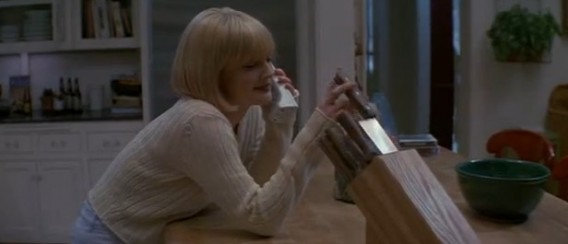
Scream (Craven 1996)


  • Titles are large and fast moving, they have sound effects involving dark music and sounds such as stabbing and screaming, creating fear from the outset.
  • To begin with cutting rate is slow and shots are long, panning is used in some areas to display the location and set. The conversation also appears the same way, it starts friendly and somewhat flirtacious and becomes somewhat more alarming over time.
  • The woman character is typical for a horror movie, she is young, blonde, flirtacious and perhaps dumb. These characters are often used in horror films as easy murders.
  • Like with many horrors, the film takes place in an American neighbourhood with nice houses, that arent particularly isolated. This is very common and is done to promote the idea that the events within the film can happen to anyone, no body is safe from the danger.
  • Relatively pleasant conversation quickly changes when man mentions he can see her, woman begins to have urgency in her voice, low and dark music is played and a dog barks as if to show unrest.
  • Piano music is used throughout, it can be done to show mystery and unknowing i.e. when she looks out at the dimly lit, foggy pool. Or as a sound of danger and shock i.e. when he tells her he can see her. The music continues this way throughout the clip.
  • (I watched up until 4:00 of this scene) We are positioned to sympathise with the woman as she is being threatened and interegated by the protagonist over the phone. This idea is also common with horror films for example The Hills Have Eyes (aja 2006) where a family are attacked brutally for no reason. Again the phone is another common technical device by which tension is created due to not being able to see the person, fear of the unknown for example When A Stranger Calls (Walton 1979)

Wednesday, 18 January 2012

AH: Conventions of a film opening

Amityville (Douglas, 2005)
http://www.youtube.com/watch?v=KF2mIvrQHpo


  • Iconography is clear with the use of props as we see a book with 'evil' titled on it and the gun he is holding. These can be seen as enigmatic codes which may be resolved later in the film. This is a generic convention of horror films, for example a gun instantly inserts an impression of danger. 
  • The lightening outside connotes a sense of urgency and horror. There are two uses of this lightening, when it is dark audiences focus more, then when there is sudden light it frightens the audience.
  • The costume and appearance of the man reinforces to the conventions of a typical horror. The antagonist is in his 20's with a beard and scruffy hair, these are all generic conventions of horror.
  • The diagetic sound of the mans footsteps, the voice in his head and the creaky floorboards are all generic conventions in horror films. Also the dialogue from the little girl at the end of the clip asserts sadness amongst audiences and draws them in. The girl says "what's the matter Ronny?". 
  • Once the man shoots the parents (first victims), several crime scene images flash onto the screen from that murder. This is consistent with all the killing in the opening apart from the last, this is an example of montage editing. The typography used is much like a typewriter and reinforces the documentation of the killings and their age. 


30 Days of Night (Slade, 2007)
http://www.watchthetitles.com/articles/0028-30_Days_of_Night


  • The clip has a soundtrack which slowly builds and builds mounting tension within the clip. Now and then there seems to be screams, this creates enigmatic codes as people want to find out what is causing the screams. 
  • The main focus of the sequence are the crinkled up and torn photos of people, the people within these photos could be the characters (victims) later on in the film.
  • The typography isn't in an abstract font, this could relate to the plot of the film as its about a significant event which takes place in the 30 days of night (which is an annual event for northern territories). 
  • The lighting shows relation to the title, with there being little light and bland colours, referring to the month of darkness.
  • The shot were a bloody tooth fall onto a surface could portray events that may take place later in the film. For example from this tooth an impression of blood and teeth in horror films are usually to do with vampires.
  • Finally at the end of the clip the last shot is of a young boy with black eyes this connotes immortality and reinforces enigmatic codes which have arisen previously in the clip.